
Burst Pipe in Winter? How Arkansas Homeowners Should Respond in the First Hour
If you’ve just discovered a burst pipe, the order of operations is simple: shut off the water, shut off the power, call us. Here are the details.
Step 1 — Shut off the main water valve
Every house has a main shutoff. Find yours BEFORE you need it — most are located:
- In a basement or crawl space near the front foundation wall
- Outside near the water meter (look for a concrete box in the yard)
- In a utility room or laundry
- Near the water heater
It’s usually a lever handle or a round handle. Lever: turn it 90 degrees so it’s perpendicular to the pipe. Round: turn clockwise until it stops. You’ll hear the flow stop in the walls within seconds.
Step 2 — Kill power to the affected rooms
If water has reached outlets, wall cavities, or the ceiling, water and electricity are now mixing inside your house. Go to your breaker panel and flip the breakers for the affected rooms. Don’t wade into standing water to reach an outlet or appliance until that room’s breaker is off.
Step 3 — Drain the remaining water from the lines
After the main is shut off, open all faucets in the house — kitchen, bathrooms, basement — and flush toilets. This drains the pressurized water still sitting in the pipes. If the break is at a high point in the plumbing, this can significantly reduce how much more water pours out of the break.
Step 4 — Call a restoration company (not just a plumber)
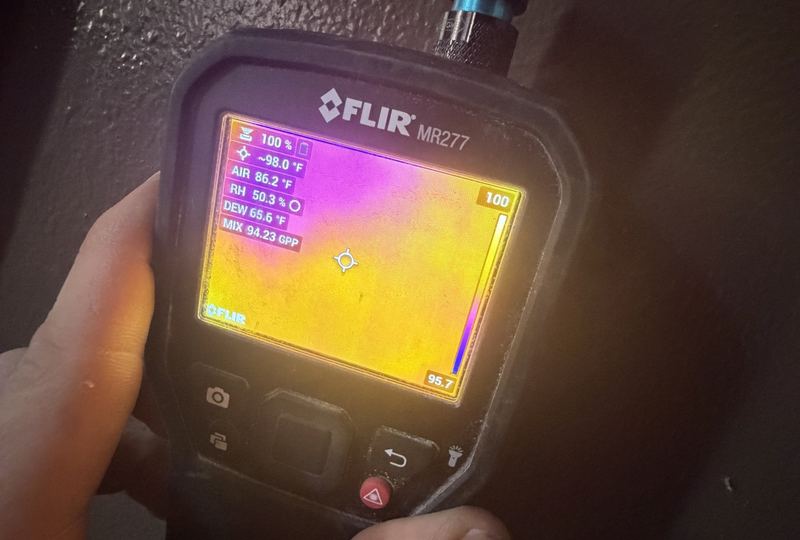
A plumber fixes the pipe. A restoration company deals with the water that’s already in the house. You need both — and you need them in the right order. The plumber first, to seal the break. Then the restoration crew, who will extract the standing water, pull wet baseboards, pull carpet pad if saturated, and run commercial dehumidifiers and air movers for 3-5 days until moisture readings are back to normal.
If you skip the restoration step and just “let it dry on its own,” you’re setting yourself up for mold in the walls, warped hardwood, and subfloor rot within 30-60 days. In Arkansas humidity, it doesn’t take long.
What makes Arkansas winter pipe breaks worse than other regions
Most Arkansas houses aren’t built for 5°F. Pipe insulation in older homes is often minimal, crawl spaces are often uninsulated, and exterior walls may have pipes running through them that never get proper heat in extreme cold. When the freeze hits, pipes in exterior walls and crawl spaces freeze first. The water expands as it freezes, splitting the pipe. You don’t notice it during the freeze (because the ice plug prevents flow). You notice it when the thaw comes — often 24-48 hours later, when suddenly water is pouring out somewhere unexpected.
This is why the “second day after the freeze” is actually our busiest day for water damage calls. The freeze happens, the break happens, but the damage only shows up when the temperature climbs back above freezing and the ice plug melts.
Prevention for next winter
- Find your main shutoff and show everyone in the household — most burst pipes cause 10× more damage because nobody could find the shutoff fast enough.
- Insulate pipes in crawl spaces and exterior walls — foam pipe insulation from the hardware store costs $3 per section.
- Drip faucets during hard freezes — moving water doesn’t freeze as easily. Open the tap to a pencil-thick stream on the coldest nights.
- Open kitchen and bathroom cabinets during freeze events so house heat reaches the pipes under sinks.
- Disconnect outside hoses before the first freeze each year. Water trapped in a connected hose can back up into the spigot and split it.
Water damage already happened? Call Steam-Pro at (870) 793-4834. We’re on-site fast across Batesville, Mountain Home, and North Central Arkansas — 24/7, every day of the year.